| 14.3.2006 |
| |
| Accelerated growth of credit from institutional investors to the business sector
in 2005
|
|
| |
 |
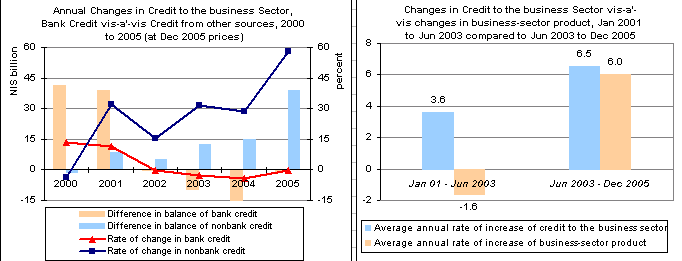
Credit to the business sector grew in 2005 by 9 percent, as a result of growth in nonbank sources, while bank credit showed no growth. Consequently, the banks' share of credit to the business sector continued to drop, reaching only 62 percent at the end of the year. |
| |
The rate of growth in credit to the business sector from institutional investors, which had been very fast in recent years, continued to accelerate during the year, with their credit balance doubling in the past two years. Almost all increase in credit during the year came from institutional investors' investment in negotiable and nonnegotiable corporate bonds, issued on the Tel Aviv Stock Exchange. |
| |
These changes in credit testify to a process of a more sophisticated and competitive credit market in the making, following many reforms in the financial system, a process that is expected to accelerate in the wake of implementation of the Bachar reforms at the end of 2005. This process boosts financial stability, chiefly through spreading exposure to credit risk in the economy, though it also poses a great challenge for institutional investors and their supervision in all matters related to credit risk. |
| Total credit in the economy, including credit to the government, to the business sector and to households from all sources totaled NIS 1,344 billion at the end of December 2005, the Financial Stability Area of the Bank of Israel announced today. Total credit in the economy grew by 5 percent in 2005, faster than the rate of growth in the past three years, when credit grew by an average of 3 percent each year. |
| Unlike in the previous three years, when significant growth in credit was mainly to the government, the increase in 2005 was entirely in credit to the private sector, mainly to the business sector, whose balance of credit rose in 2005 by NIS 47 billion. Credit to the government remained unchanged although the government's share of credit in the economy is still high at 41 percent. These changes indicate a process of reverting to a more stable situation in which the government's share of the credit market declines, freeing funds for the business sector––a process that is the outcome of the reduction in the budget deficit and a return to a downward path for the government debt/GDP ratio. |
| Economists in the Financial Stability Area of the Bank of Israel note that the rate of growth in credit to the business sector reached 9 percent in 2005, a significantly higher rate than credit growth registered in the preceding three years––0-3 percent––and also higher than the growth of business sector product in 2005 of 6.7 percent. Nonetheless, it appears that this increase in credit is consistent with the preservation of financial stability, as, viewing developments in the past three years, the relationship between the rise in credit and the increase in real activity has been maintained. |
| Economists in the Financial Stability Area note that the rise in credit to the business sector in 2005, as in the preceding three years, came from nonbank sources, while bank credit, which had contracted in these years, remained unchanged. As a result, the downward trend of the banks' share of credit to the business sector persisted; This was down to only 62 percent by the end of 2005, compared with 77 percent at the end of 2000. Almost all of the additional nonbank sources of credit during the year originated from institutional investors––pension funds, insurance companies and provident funds. Households accounted for only a small part of the growth in credit to the business sector and direct credit from nonresidents did not grow. The rate of growth of credit from institutional investors to the business sector, which was high in preceding years, continued to accelerate in 2005, reaching 58 percent. In effect, credit to the business sector from institutional investors has doubled in the past two years. As a result, institutional investors' share of the balance of credit to the business sector has, for the first time, surpassed that of nonresidents, reaching 19 percent. |
| These changes were also reflected in the method of financing of the business sector; more through bonds, negotiable and nonnegotiable, and less through loans. During the year, the business sector issued NIS 42 billion of negotiable and nonegotiable bonds on the Tel Aviv Stock Exchange, more than twice the issues of the preceding two years. As a result, the share of bonds (negotiable and nonegotiable) in total credit to the business sector continued to rise at a rate of 5 percentage points, reaching 25 percent of the total, compared to only 10 percent in 2000. The continued rise in this share strengthens financial stability by boosting the transparency and fair pricing of debt, and reinforcing market mechanisms as stabilizing means of control. |
| Economists in the Financial Stability Area believe that the accelerated expansion of nonbank credit, especially from institutional investors who buy bonds, at the expense of growth in bank credit, indicates a process of creating a sophisticated and more competitive credit market. This process is the outcome of liberalization and reform of the financial system in the last few years, contributing to financial stability through broadening the range of credit sources available to companies and reducing their dependence on bank credit, reducing banks' exposure to large borrowers, making the banks less dominant in the financial market and in the economy as a whole, and helping the development of the capital market. At the same time, this process poses a complex challenge in the coming years for the major players in the financial system, especially the institutional investors, and the supervisory authorities, regarding how to deal with credit risks in all their aspects. |
|
| |
| Total credita and the distribution of credit to the business sector, 2000 to 2005 |
|
| |
2000 |
2001 |
2002 |
2003 |
2004 |
2005 |
| End-period balance, NIS billion (at December 2005 prices) |
| Total credit |
| Total creditb |
1,101 |
1,186 |
1,212 |
1,257 |
1,293 |
1,344 |
| Credit to the governmentb |
451 |
482 |
493 |
538 |
553 |
552 |
| Credit to the business sector |
445 |
493 |
505 |
506 |
523 |
570 |
| Credit to households |
205 |
211 |
214 |
213 |
217 |
222 |
| Credit to the business sector |
| Total |
445 |
493 |
505 |
506 |
523 |
570 |
| Bank credit |
342 |
381 |
381 |
371 |
356 |
355 |
| Nonbank credit |
103 |
112 |
124 |
135 |
167 |
214 |
| From institutional investors |
26 |
34 |
40 |
52 |
67 |
106 |
| From nonresidents |
75 |
76 |
83 |
79 |
90 |
92 |
| From households (mutual funds) |
1 |
1 |
2 |
4 |
10 |
17 |
| (percent) |
| Distribution of credit by source |
| Banks |
76.9 |
77.4 |
75.5 |
73.3 |
68.1 |
62.4 |
| institutional investors |
5.8 |
7.0 |
7.8 |
10.3 |
12.8 |
18.6 |
| nonresidents |
16.9 |
15.5 |
16.4 |
15.5 |
17.2 |
16.1 |
| households (mutual funds) |
0.3 |
0.2 |
0.3 |
0.9 |
1.9 |
2.9 |
| Distribution of credit by tradability |
| Share of tradable bonds in total creditc |
6.9 |
7.5 |
7.8 |
8.3 |
10.0 |
13.8 |
| Share of nontradable bonds in total credit |
3.5 |
4.1 |
4.8 |
6.6 |
8.4 |
11.2 |
| Share of loans in total credit |
89.6 |
88.4 |
87.4 |
85.0 |
81.6 |
75.0 |
| Rate of change from previous year |
| Total credit |
11.7 |
10.7 |
2.4 |
0.3 |
3.3 |
9.0 |
| Bank credit |
13.7 |
11.3 |
-0.1 |
-2.5 |
-4.1 |
-0.2 |
| Nonbank credit |
5.7 |
8.6 |
10.9 |
9.0 |
23.5 |
28.6 |
| of which from institutional investors |
-3.9 |
32.0 |
15.5 |
31.5 |
28.4 |
58.2 |
| Business-sector product |
9.7 |
-1.5 |
-3.3 |
2.5 |
6.3 |
6.7 |
|
| |
|
|
| |
| a |
Total credit including loans and tradable and nontradable bonds to the government, the business sector and households made available to them by the banks, insurance companies, provident funds, pension funds, nonresidents, and households (mutual funds). |
|
|
|
|
|
|
|
|
|
| b |
After deducting NIS 12 billion, the estimated revaluation of earmarked bonds held by pension funds that was carried out first in April and May 2005. Nontradable bonds of the bhusiness sector were also revalued in the institutions' assets portfolios, but this is not deducted from credit to the business sector as its effect is relatively minor. |
| c |
Private bonds traded on the Tel Aviv Stock Exchange do not include structured bonds, certificates of deposit and bond ETFs, which do not serve as sources of financing for the business sector. |
| SOURCE: Based on Bank of Israel data, and data from the Capital Market Division of the Ministry of Finance and the Tel Aviv Stock Exchange. |
|
|
|
|
|
|
|
|
|
| |
|
|