| 10.5.2005 |
| |
| New Research in the Bank of Israel
"Competition in Banking: Theoretical Aspects and Empirical Evidence from Israel and Abroad"
|
|
| |
| The views expressed in the research do not necessarily reflect those of the
Bank of Israel
|
| |
|
| The findings of the research into competition in Israel's banking industry, written by Professor David Ruthenberg, Assistant Supervisor of Banks and Head of the Banking Supervision Research Department of the Bank of Israel, are that the degree of competitiveness in Israel is currently lower than that which prevailed until the middle of the 1990s––competition has decreased in the last few years––and also lower than banking systems in other countries, including countries comparable to Israel. |
| |
|
| Two weak points with regard to competition were found in Israel's banking system: |
| a. |
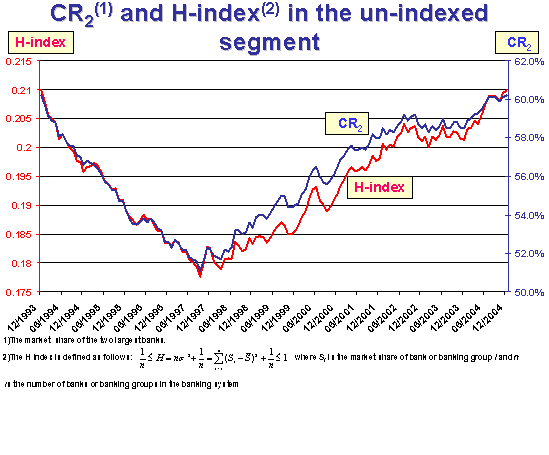
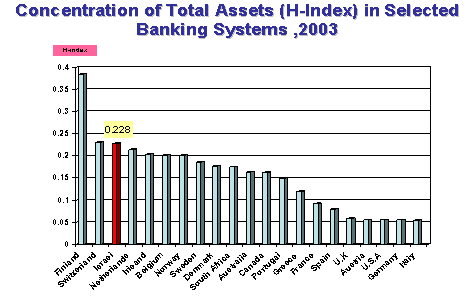
The system is very highly concentrated, which in itself increases the market power that the banks exercise over their customers (essentially over households). This concentration has intensified in the last few years. In practice the banking system in Israel is dominated by the largest two banks. Concentration in Israel is among the highest in the world. |
| b. |
The appropriate conditions are lacking for the creation of a proper competitive threat to the banking system from nonbank financial institutions in Israel and abroad, such as insurance companies, investment banks, and a developed capital market that could offer a range of financial products which would serve as substitutes for those offered by the banks. |
| |
|
| Whereas certain banking system abroad were very competitive despite a high degree of concentration, due to the serious threat of competition to the system (e.g., in Canada, Greece, the Netherlands and Sweden), in Israel the lack of competitiveness is the result of the high concentration of the banking system combined with the absence of a reasonable competitive threat from nonbank financial institutions. |
| |
|
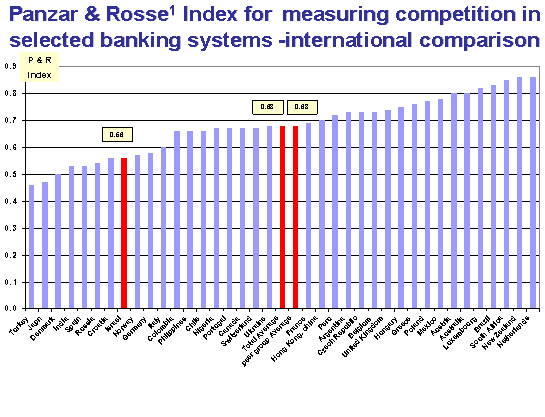
| The research contains a calculation of the Panzar and Rosse statistic of concentration for Israel's banking system. This statistic expresses the effect of changes in prices of banking factor inputs––capital, labor and financial sources––on the bank's revenue. A high value of the statistic (close to 1) indicates a high degree of competitiveness, and a value close to zero, or even negative, low competitiveness. This index shows that the competitive threat in Israel is lower than its average value in many other banking systems, and is also lower than the average for Israel's reference group of countries that includes Belgium, Denmark, Finland, Greece, Ireland, Norway, Portugal and South Africa. |
| |
|
| The research concludes that the unequivocal findings regarding the relatively low level of competitiveness in Israel's banking system, which has become even worse in the last few years, requires decisive measures to be taken to make the industry more competitive. The author of the research is of the opinion that these steps should not necessarily focus exclusively on reducing the degree of concentration in banking, but should also attempt to encourage the competitive threat to the banking system. The latter can be achieved by deepening the money and capital markets and making them more efficient, on the one hand, thus enabling companies to raise capital as an alternative to bank credit, and on the other by increasing the competitive threat from domestic and foreign financial institutions, for example insurance companies, investment banks, and institutional investors such as provident funds, mutual funds and pension funds, that would offer an extensive range of alternatives to bank credit and deposits. These measures should be encouraged, against the backdrop of a consensus in the current literature on competitiveness that a contestable system has a stronger effect on competition than does a system with a low degree of concentration. The banking systems of Canada, the Netherlands and Sweden serve as good examples of this, as they are highly concentrated, like Israel's, but are very exposed to competitive threat, so that their systems are more competitive than Israel's . |
|
| |
|
|
|
|
| |
|
|
|
|
| |
|
|
|
|
| |
|