To view this message as a file, click here
- Exchange Rate Development
A strengthening of the shekel alongside a strengthening of the dollar worldwide.
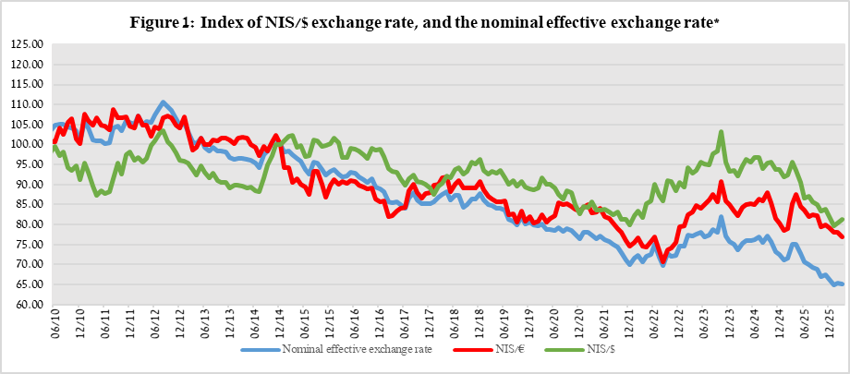
In the first quarter of 2026, the shekel strengthened by approximately 0.8 percent vis-à-vis the US dollar and by about 2.9 percent against the euro. In addition, the shekel strengthened by about 1.9 percent against the currencies of Israel's main trading partners, in terms of the nominal effective exchange rate (i.e., the trade-weighted average shekel exchange rate against those currencies).
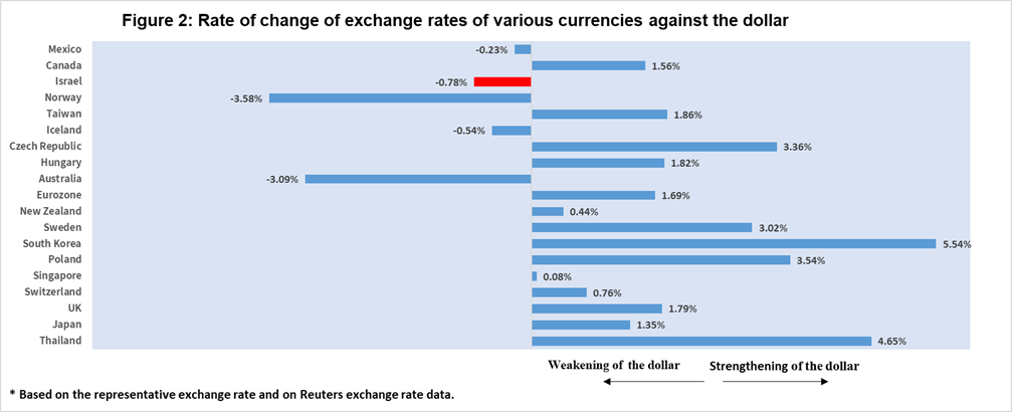
During the first quarter, the US dollar strengthened against most of the major currencies, (Figure 2), including by about 1.6 percent against the Canadian dollar and about by 1.8 percent against the British pound.
- Exchange Rate Volatility
Increase in actual volatility alongside an increase in implied volatility
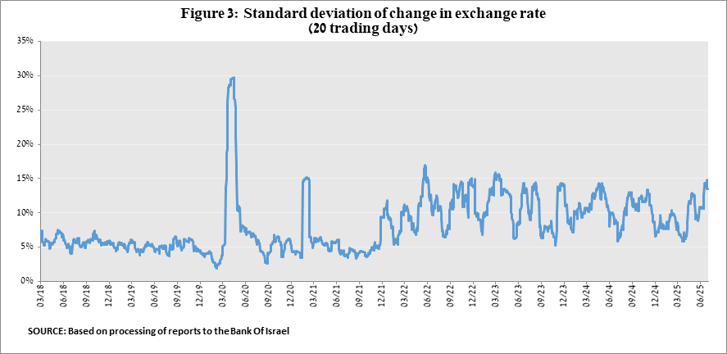
The average actual standard deviation of changes in the shekel/dollar exchange rate, which represents its actual volatility, increased by 0.3 percentage points during the quarter, to an average level of 8.4 percent. The increase in actual volatility came against the background of Operation Roaring Lion (Israel’s campaign against Iran), which contributed to the increase in market volatility.
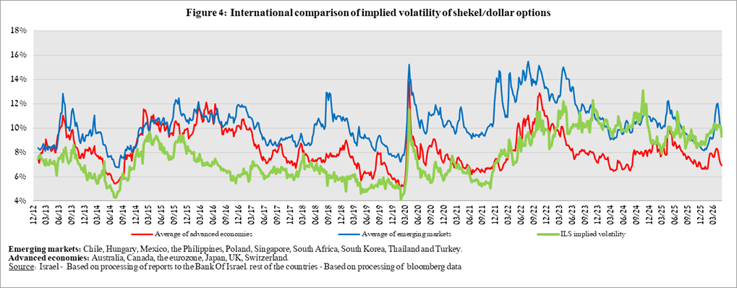
The average implied volatility in over-the-counter shekel/dollar options—those traded outside the stock exchange—which is an indication of expected exchange rate volatility, increased by 0.9 percentage points, to an average level of about 9.7 percent at the end of the quarter. This is alongside the average level of implied volatility in foreign exchange options in emerging markets, which increased by 1.0 percentage point compared to the previous quarter, to 9.6 percent at the end of the quarter. There was a similar increase in advanced economies, to 7.6 percent at the end of the quarter (Figure 4).
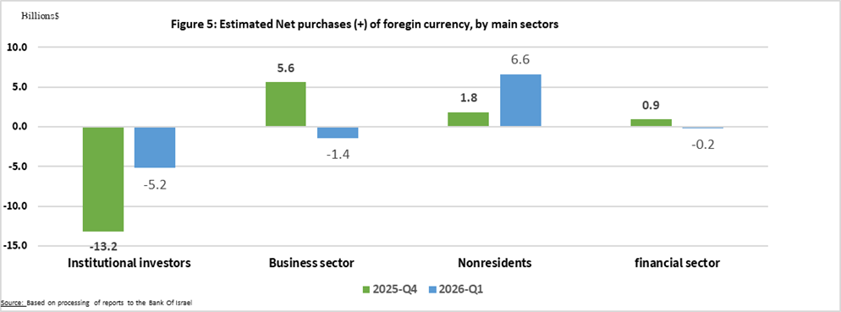
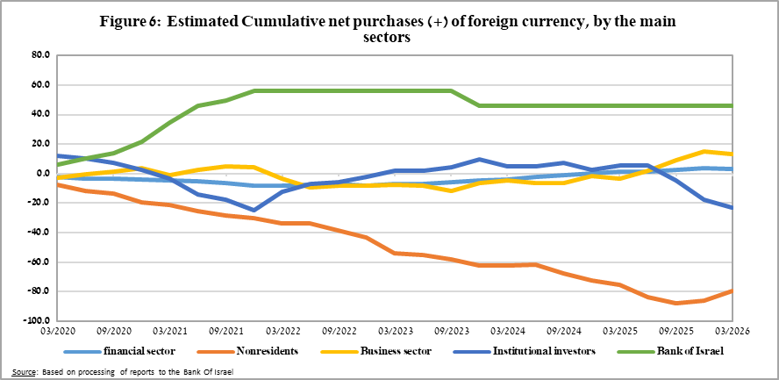
An estimate of activity by the main segments in the foreign exchange market indicates heterogeneous activity. In the first quarter, there were net foreign exchange purchases by nonresidents, while institutional investors and the business sector made net sales, which supported the strengthening of the shekel. The activity of the financial segment was relatively moderate.
Nonresidents increased their net foreign exchange purchases to about $6.6 billion, compared with $1.8 billion in the previous quarter. The institutional investors—pension funds, provident funds, and insurance companies—continued to make net foreign exchange sales, totaling about $5.2 billion during the quarter, compared with sales of about $13.2 billion in the previous quarter.
The business sector moved to net foreign exchange sales, totaling about $1.4 billion in the first quarter, compared to purchases of about $5.6 billion in the previous quarter. The financial sector (mainly the banks) made net foreign exchange sales totaling about $0.2 billion in the first quarter, compared with purchases of about $0.9 billion in the previous quarter.
- Trading Volume in the Foreign Currency Market—Tables and Figures
Trading volume vis-à-vis the domestic banking system[3]
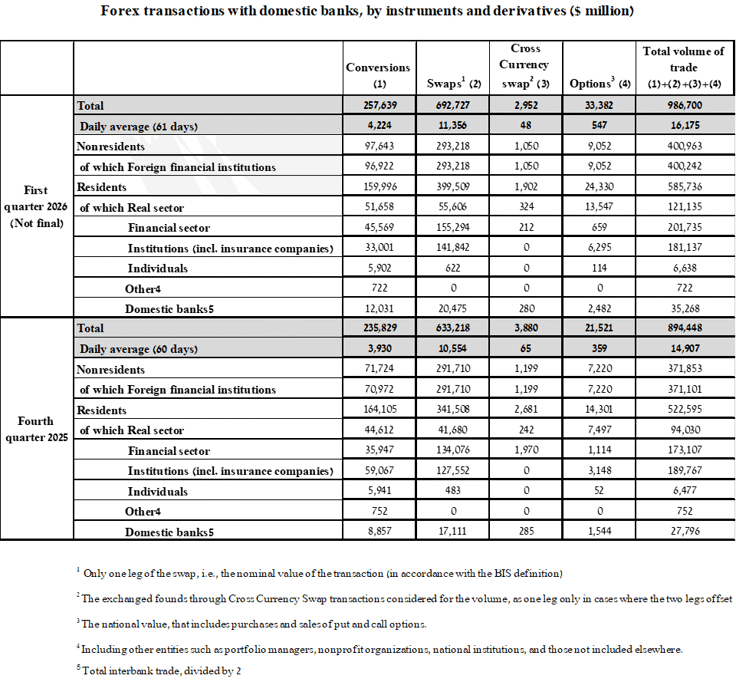
The average daily trading volume increased by about 8.5 percent during the first quarter, to $16.2 billion, with most of the increase coming from swap transactions.
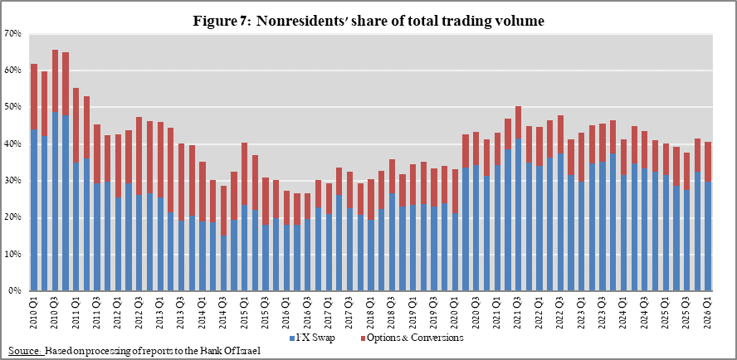
Nonresidents' share of total trading volume vis-à-vis the domestic banking system (spot and forward transactions, options, and swaps) declined by about 1 percentage point to about 40.6 percent at the end of the first quarter .
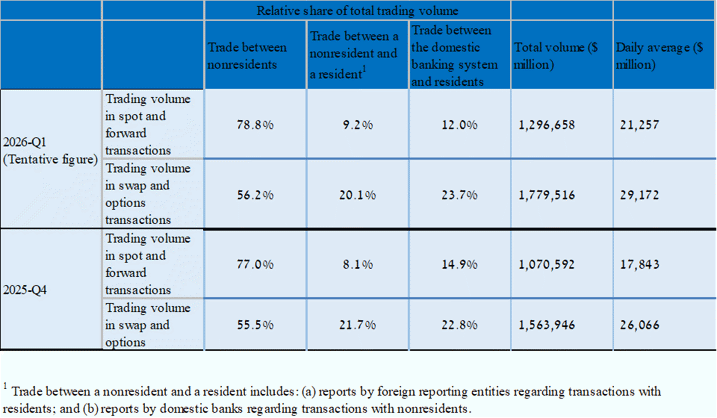
Estimated total trading volume[4]—domestic banking system and foreign reporting entities
The estimated total activity in transactions against the shekel, as reflected in reports from the domestic banking system and foreign reporting entities, indicates that nonresidents’ share of trading volume in spot and forward transactions (excluding swaps and options) was about 88 percent in the first quarter.
Trade between nonresidents constituted about 79 percent of the volume, which had a daily average of about $21.3 billion.
[1] For additional information on the segments’ activity in the foreign exchange market, see “Statistical Bulletin” 2024—Chapter D.
[2] The main segments presented do not make up the entire market—for additional information, see the section on “The Database of Foreign Exchange Market Activity” in the Bank of Israel’s “Statistical Bulletin” for 2024
[3] From the beginning of 2020, the data do not include branches of foreign banks in Israel.
[4] Total trading volume is an estimate of total activity in transactions against the shekel, based on reports by the domestic banking system and by foreign reporting entities.